From Prestige to Amanah: A Kuhnian–Kahnemanian Paradigm Shift in Pakistani Academia Through Islamic Virtue Ethics and Indigenous Decolonial Thought
The crisis of Pakistani academia is frequently described in terms of corruption, underfunding, bureaucratic inefficiency, political interference, or declining research quality. While these diagnoses capture important dimensions of the problem, they often remain confined to the surface level of institutional symptoms. A deeper analysis suggests that the fundamental challenge is epistemic and civilizational rather than merely administrative. The central issue is not simply the absence of resources or regulations, but the dominance of a prestige-centered knowledge culture in which symbolic status increasingly displaces genuine inquiry. Understanding this condition requires moving beyond conventional discussions of governance and toward an examination of the moral, cognitive, and cultural architectures that shape academic life.
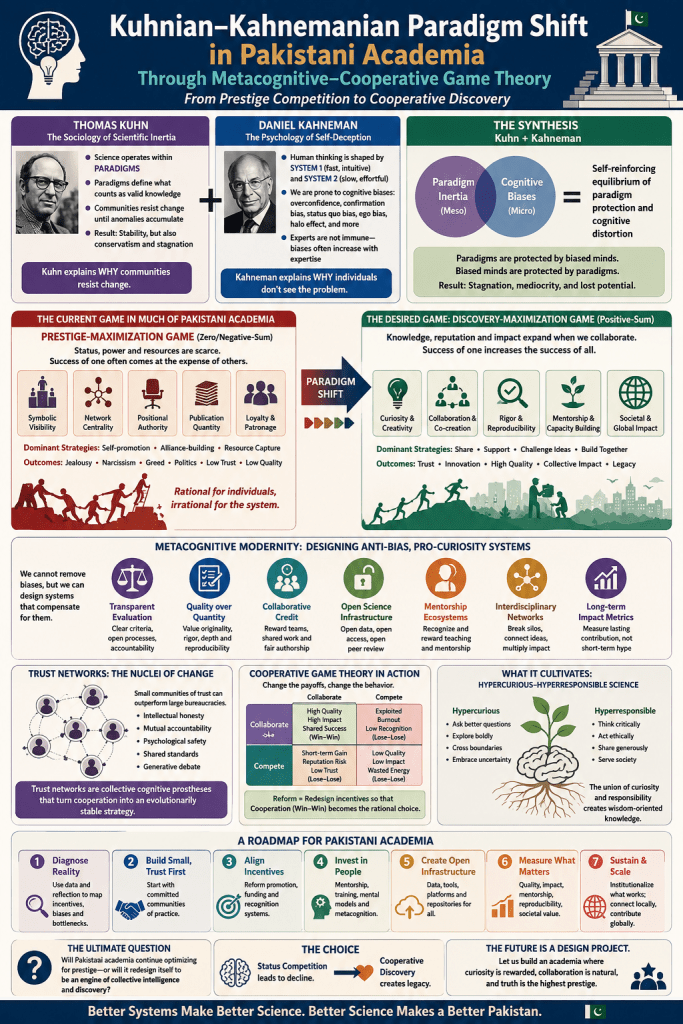
The synthesis of Thomas Kuhn’s theory of paradigms and Daniel Kahneman’s theory of cognitive biases provides a powerful framework for such an analysis. Kuhn demonstrated that scientific communities are not purely rational truth-seeking enterprises but social systems organized around paradigms that define legitimate questions, acceptable methods, and standards of evidence. These paradigms generate stability and cumulative progress, yet they also create inertia by discouraging challenges to established assumptions. Kahneman, operating at the level of individual cognition, revealed that human judgment is systematically shaped by biases such as overconfidence, confirmation bias, authority bias, motivated reasoning, and status quo bias. Together, Kuhn and Kahneman reveal that scientific stagnation is not merely a consequence of inadequate knowledge. It emerges when institutional paradigms and cognitive distortions become mutually reinforcing.
In many academic environments, particularly those characterized by scarcity and intense competition for recognition, prestige becomes a self-validating system. Hierarchies are interpreted as evidence of merit. Visibility becomes confused with value. Seniority becomes mistaken for wisdom. Administrative authority begins to masquerade as intellectual authority. A self-reinforcing equilibrium emerges in which paradigms protect prestige structures while cognitive biases protect paradigms. The resulting system may appear stable, but it often becomes epistemically unproductive. Knowledge production gradually gives way to prestige reproduction.
The deeper significance of this diagnosis becomes apparent when viewed through the lens of Islamic virtue ethics. Classical Islamic intellectual traditions never understood knowledge merely as information acquisition or credential accumulation. Knowledge was inseparable from moral cultivation. The pursuit of knowledge was understood as an ethical vocation grounded in sincerity (ikhlāṣ), trustworthiness (amānah), wisdom (ḥikmah), proper conduct (adab), and service (khidmah). The scholar was not simply a producer of information but a custodian of a sacred trust. Knowledge carried obligations toward God, community, and future generations.
From this perspective, many contemporary academic pathologies appear not merely as institutional failures but as failures of character formation. When universities reward visibility over understanding, patronage over competence, and self-promotion over service, they unintentionally cultivate the very vices that classical virtue traditions sought to restrain. Jealousy, narcissism, greed, vanity, and status-seeking cease to be individual weaknesses and become structurally incentivized behaviors. The institution itself becomes a training ground for the lower self (nafs).
Remarkably, Kahneman’s psychology converges with this virtue-ethical tradition. His demonstrations of overconfidence, motivated reasoning, and self-serving narratives closely parallel classical Islamic discussions of ghurūr (delusion), ʿujb (self-admiration), and hawā (ego-driven inclination). Although the methodologies differ, both traditions arrive at a similar conclusion: human beings are poor judges of themselves and require systematic disciplines of self-correction. What Islamic spirituality calls muḥāsabah—the continual practice of self-accounting—appears in Kahneman’s work as a cognitive necessity. Metacognitive modernity can therefore be interpreted as an institutionalized form of collective muḥāsabah, a social architecture designed to compensate for the predictable distortions of human cognition.
This interpretation acquires further depth when examined through Indigenous and decolonial perspectives. Many Indigenous knowledge traditions reject the separation between knowledge, ethics, community, and ecology that characterizes much of modern institutional life. Knowledge is not treated as a commodity to be owned, accumulated, and exchanged for prestige. Rather, it is understood as a relationship involving reciprocal obligations among persons, communities, ancestors, future generations, and the natural world. The knower is not a detached observer but a participant within a living web of responsibilities.
From this standpoint, the prestige-centered academic system represents a form of epistemic extractivism. Knowledge becomes something to be mined for career advancement rather than cultivated for communal flourishing. Publications become symbolic currency. Degrees become markers of rank. Intellectual activity becomes increasingly detached from the communities it ostensibly serves. Such dynamics mirror broader colonial patterns in which knowledge was transformed into an instrument of classification, administration, and hierarchy.
Decolonization, therefore, should not be reduced to the rejection of Western science nor to the romanticization of tradition. Rather, it requires recovering forms of knowledge that remain accountable to ethical relationships and communal well-being. The challenge is not to abandon scientific inquiry but to reconnect it with moral purpose. The question becomes how scientific institutions can be redesigned so that knowledge once again functions as a public trust rather than a private asset.
This is where the concept of metacognitive-cooperative game theory becomes particularly relevant. Traditional academic systems often operate as prestige-maximization games. Researchers compete for symbolic visibility, bureaucratic influence, network centrality, and publication counts because these factors determine access to resources and opportunities. Within such systems, behaviors that appear morally troubling may nevertheless be strategically rational. The problem is not primarily individual character but the structure of incentives.
Metacognitive-cooperative game theory proposes a different equilibrium. Instead of rewarding prestige accumulation, institutions reward contributions to collective intelligence. Instead of measuring success through individual visibility, they evaluate the extent to which scholars enable discovery, mentorship, collaboration, and societal benefit. The central question shifts from “Who receives credit?” to “What forms of knowledge become possible through cooperation?”
Such a transformation would represent a profound civilizational shift. It would move academia from a prestige economy toward a trust economy. Trust networks, communities of practice, and distributed mentorship structures would become more important than rigid hierarchies. Authority would increasingly derive from demonstrated contribution rather than inherited status. Legitimacy would emerge from service to knowledge rather than control over knowledge.
This vision resonates deeply with both Islamic and Indigenous traditions. In Islamic terms, it represents a transition from nafs to amānah—from self-centered acquisition to stewardship. In Indigenous terms, it represents a transition from extraction to relationship. In Kuhnian terms, it is a paradigm shift. In Kahnemanian terms, it is the conscious redesign of institutions around the realities of human cognitive limitations.
The future of Pakistani academia may therefore depend less on additional regulations, rankings, and administrative reforms than on a transformation in its underlying moral and epistemic architecture. The ultimate challenge is not merely increasing research output but cultivating a culture in which curiosity is inseparable from responsibility, authority is inseparable from service, and knowledge is inseparable from wisdom. Such a transformation would move the university beyond the prestige-centered logic inherited from both colonial bureaucracies and contemporary metric-driven systems. It would establish a new equilibrium in which the highest status accrues not to those who accumulate symbolic capital, but to those who most effectively nurture collective intelligence, ethical inquiry, and the cooperative pursuit of truth.
At its deepest level, the Kuhnian–Kahnemanian paradigm shift is therefore not simply an academic reform agenda. It is a civilizational transition from ownership to stewardship, from hierarchy to reciprocity, from self-promotion to service, and from prestige to amānah. It seeks nothing less than the reconstruction of the university as a moral and cognitive commons dedicated to the flourishing of knowledge, community, and future generations.
 A spiritual Ishmaelite
Leave a comment